Why Does the Same Miku Have Five Different Faces?
I once lined up five Hatsune Miku scale figures in front of my display case. They were the same character sculpted by Good Smile, Alter, Max Factory, Kotobukiya, and FREEing, but not a single face resembled another. Good Smile's Miku had round eyes with slightly upturned corners of her mouth, Alter's Miku had subtle pearl embedded in her skin, and Max Factory layered three levels of highlights inside the irises to breathe life into them. Kotobukiya's Miku had a sharp jawline and unusually long legs. To cut to the chase, these differences aren't simply a matter of "individual sculptor habits." They reflect what kind of sculptor pool each manufacturer operates, what painting philosophy they hold, and what customer base they target. Looking back at the figures that have filled my display case from the late 2000s until now, I'm newly struck by how distinct each manufacturer's "touch" truly is.
Every collector who entered through Nendoroids and fell into the scale figure rabbit hole experiences a certain moment. When you pre-order based on the master sample photos and the production version arrives, you mutter, "This looks different from the pictures." And then you realize: Good Smile products generally have minimal gap between photos and actual product, Alter products' impressions completely change depending on the angle, and Kotobukiya's paint quality occasionally varies wildly between production lots. To dismiss these differences as "luck" or "winning the lottery" is too simplistic—the patterns are far too consistent. Each manufacturer has different quality control standards and production processes, and these have solidified into brand identities.
Good Smile Company: Stability as Brand Value
The word you can't leave out when discussing Good Smile is "stability." Since its founding in 2001, they've dominated the articulated figure market with Nendoroids and figma, and in the scale line they've established themselves as a manufacturer with virtually no "photo fraud." Their production quality maintains an 80-85% level compared to master samples, which may seem low but is actually the most consistent figure in the industry. It contrasts sharply with Alter's volatility of hitting 90% then plummeting to 70%.
Good Smile's scale figures generally lean toward the "cute" direction. They increase eye size by about 5% from the original work, make the cheeks slightly plumper, and raise the mouth corners slightly to create a friendly impression. This isn't individual sculptor preference but company-level guidelines. Indeed, when you compare the work of Good Smile's in-house sculptors—Nakano Shunsaku, Moriyama Koichi, Matsuda Tetsuya—their character interpretations differ but they all share the overarching framework of "making it cute." The painting is similar. Good Smile uses bright skin tones, prefers solid base colors over gradients, and minimizes gloss for an almost matte finish. As a result, they don't shine garishly under lighting, and the failure rate from reflections when photographing is low.
The drawbacks are also clear. Many say that while stable, they're bland. Good Smile figures don't "pop" when displayed in a case. You can't expect flashy diorama bases or bold poses; bases often end up as simple circles or hexagons. Good Smile focuses on making figures that "don't fail," not on aiming for "masterpieces." So in my display case, Good Smile scales have always been the "safe choice," never the "favorite among favorites."
Alter: Between Splendor and Instability
I first encountered Alter around 2009. Seeing the 1/7 scale Saber Lily from "Fate/stay night" released at the time, I learned for the first time that figures could be this "beautiful." The pearl embedded in her blonde hair, the fine engravings on the armor's gold trim, the light gradient reflected on the blade. The master sample photos were truly works of art. And when the production version arrived and I saw the smudged shadow processing under the chin and peeling plating on the sword tip, I realized Alter's duality.
Alter is "either the best or the worst." They reach the highest peaks among manufacturers, but simultaneously dig the deepest valleys. Alter's sculptor pool—Kurosaki Asaba, Sakurai Takahiro, Kimura Shinji—all have intense individuality, and the company respects that individuality. As a result, even under the same "Alter" name, styles vary wildly from piece to piece. But the painting process is consistently splendid. They mix pearl into the skin, process hair tips with clear parts, and put at least 3-tier gradients on clothing. Bases aren't simple discs either; they're often diorama formats reflecting character settings.
The problem is the production process. Alter often outsources painting to Chinese partner companies, and these partners' quality variance is severe. If you dig through Alter production reviews from around 2015, you'll find half saying "this lot is amazing" and half "this one's a disaster." The more perfect the master sample, the greater the gap with the production version, so pre-ordering Alter releases always feels like gambling. When I pre-order Alter scales, I always wait until production reviews come out. Often it's more comfortable to wait patiently for a second run.
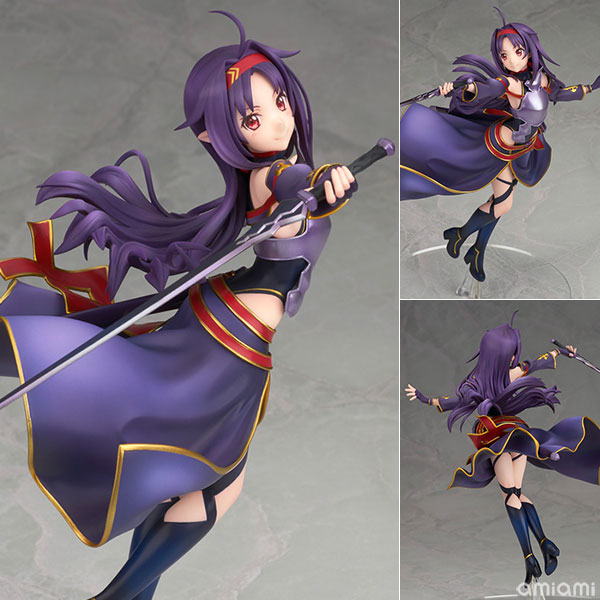 Sword Art Online Yuuki 1/7 Complete Figure →
Kotobukiya: Figures Made by a Plastic Model Manufacturer
Kotobukiya is originally a plastic model maker. Having produced Gunpla-compatible kits since the 1990s, the concepts of "assembly" and "disassembly" remain in their figures. When you open a Kotobukiya scale, you'll find an unusually high number of separated parts. Not just arms, legs, and head, but skirts and hair are also divided into multiple pieces. Some even include assembly instructions. This can be an advantage—you can disassemble parts for detailed cleaning or make fine adjustments to posing.
Kotobukiya's sculpting style is "sleekness." They extend the legs, narrow the waist, and sharply carve the jawline. Even the same character transforms into an 8-head-tall beauty through Kotobukiya's hands. This owes much to the influence of in-house sculptor Takeyama Tomofumi. He's worked on numerous mecha-girl figures like Strike Witches and IS: Infinite Stratos, and his style emphasizing the harmony between weapons and human body has become Kotobukiya's overall tone.
The drawback is inconsistent paint quality. Kotobukiya has no in-house factory and distributes orders among various Chinese partners. So even the same product has different quality depending on production timing. For the "Sword Art Online" Asuna scale released in 2018, initial stock had vivid hair gradients, but reproduction batches had blurred boundaries according to numerous reviews. When buying Kotobukiya figures, checking reviews immediately post-release is essential.
Max Factory: figma's DNA in Scale Form
Max Factory is a Good Smile subsidiary, but its identity is distinctly different. While Good Smile pursues "stability," Max Factory enjoys "experimentation." Applying the joint design know-how accumulated from making the figma articulated figure series to scales, they sometimes include interchangeable face or arm parts even in scale figures. The "Viper's Creed" Safiria scale released in 2020 even incorporated ball joints in the neck and arms, allowing limited pose changes.
Max Factory's scales have "living" expressions. They layer multiple highlights inside the irises for depth and delicately sculpt eyebrows and mouth shapes to express emotion. Max Factory's in-house sculptor Asai Masaki particularly excels in this area. The "Love Live!" Nishikino Maki scale he worked on perfectly recreated a "coy smile" with only one corner of the mouth slightly raised, earning it recognition as a masterpiece among fans.
The painting is also distinctive. Max Factory sets skin tones slightly darker than Good Smile and adds subtle blush to cheeks and nose tip. Hair mixes clear and matte parts so the impression changes with light reflection. However, prices run high. Max Factory 1/7 scales typically cost 15,000-18,000 yen, about 20% more expensive than same-size Good Smile figures. This is due to the cost of interchangeable parts and meticulous painting.
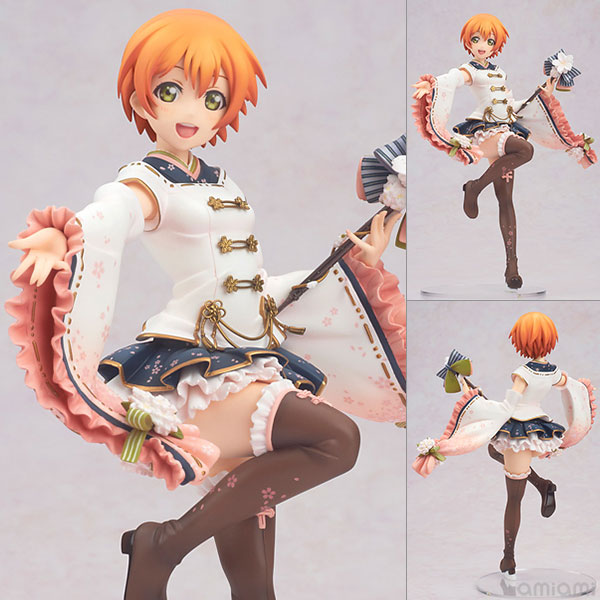 Love Live! School Idol Festival - Rin Hoshizora March Ver. 1/7 Complete Figure →
FREEing and BellFine: Sexiness as Strategy
FREEing and BellFine are manufacturers that pioneered the market with "adult-oriented" figures. Both companies exaggerate characters' body curves, minimize clothing, and set poses provocatively. FREEing's "Bunny Girl" series and BellFine's "AlphaMax" line were created targeting adult collectors from the start. The approach emphasizes "appeal" over the character's original setting.
FREEing particularly excels at bunny girl outfits. Their technology for rendering fishnet stockings with actual fabric material and recreating leotard luster with PVC and enamel paint is outstanding. The bunny version of Shiina Mashiro from "The Pet Girl of Sakurasou" released in 2017 had fishnet texture so precise it was nearly indistinguishable from real fabric. However, the poses are so aggressive that displaying them in cases is often uncomfortable. I tend to keep FREEing scales stored in their boxes.
BellFine goes one step further than FREEing. They often provide removable clothing parts or sculpt underwear in detail. The "To LOVE-Ru" Lala scale released in 2019 had a structure where removing the skirt part revealed underwear sculpting. Among collectors there's a joke that "BellFine doesn't make figures, they make sculptures." The sculpting quality is indeed high, but they appeal more to collectors who enjoy "sculptural beauty" itself rather than character fans.
Individual Sculptors' Traces: Beyond the Logo to the Fingertips
The sculptor's name is as important as the manufacturer's logo. Even within Good Smile products, the atmosphere completely changes depending on who the sculptor is. For example, figures sculpted by Moriyama Koichi have dynamic clothing folds and dynamic poses. In contrast, Nakano Shunsaku prefers static poses and focuses on accessory details. Though they work for the same company, when you place their work side by side, they look like products from different manufacturers.
Alter's Kurosaki Asaba is called the "magician of faces." He adjusts eyebrow angles in 0.5mm increments to capture a character's personality in their expression. The "Puella Magi Madoka Magica" Tomoe Mami he sculpted became legendary among fans for having loneliness hidden within a gentle smile reflected in her eyes. Meanwhile, Sakurai Takahiro excels at sculpting "objects" like clothing and weapons. The "Kantai Collection" Yamato he worked on had gun turrets and deck details at military model levels.
Sculptor information can be found on the side of the figure box or the official product page. Rather than pre-ordering based only on the manufacturer's logo, checking the sculptor's name as well significantly reduces failure rates. I keep a separate list of "favorite sculptors." When new work involving them comes out, I add it to my watchlist regardless of manufacturer.
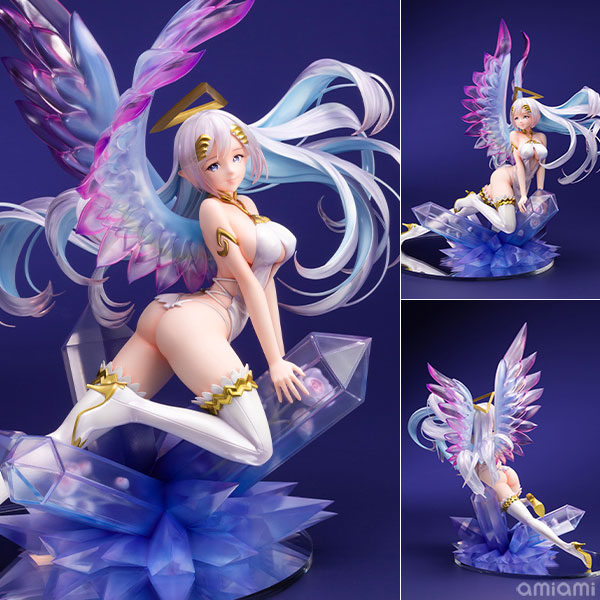 Museum of Mystical Melodies Verse01: Aria -The Angel of Crystals- 1/7 Complete Figure →
The Rebellion of Small Manufacturers: Aniplex+ and Union Creative
Beyond major manufacturers like Good Smile and Alter, there are small makers receiving recent attention. Aniplex+ is a subsidiary of animation production company Aniplex, directly producing figures of their own works. They've released pieces like the 1/8 scale Tanjiro from "Demon Slayer" and the 1/7 scale Mash from "Fate/Grand Order," with quality matching major companies. The clothing details are especially outstanding. Tanjiro's figure had checkered patterns engraved even on the inside of his haori (outer garment), and the knots on the sword sheath strap were sculpted.
Union Creative was originally a garage kit maker that entered the scale market in the mid-2010s. They built recognition with works like "Overlord" Albedo and "One Punch Man" Tatsumaki, and recently stand shoulder to shoulder with major companies. Union Creative's strength is "bold posing." Rather than static standing poses, they prefer dynamic scenes of jumping or attacking. The Tatsumaki figure used transparent supports to realize a floating appearance, vividly recreating a psychic power usage scene.
Small manufacturers' weakness is distribution. Good Smile and Alter have domestic official distributors making purchases easy, but small company products require Japanese proxy shopping or forwarding services. Release delays are also frequent. Nearly all Aniplex+ releases since 2020 have been delayed by at least 3 months. But the quality is guaranteed, so they're worth waiting for.
FAQ
Which manufacturer would you most recommend to beginners?
I recommend Good Smile Company. The gap between master samples and production versions is small, reducing disappointment probability, and pricing is reasonable. If you entered through Nendoroids, moving to scales from the same manufacturer is natural, and Good Smile has domestic official distributors making purchases easy. Just develop the habit of checking production reviews before buying, and you'll get satisfactory results most of the time.
What should I watch out for when pre-ordering Alter figures?
Always wait for production reviews. Alter's master sample quality is top-tier, but variance in the production process is large. It's safer to check unboxing photos and reviews posted by Japanese collectors immediately after release before deciding to purchase. Waiting patiently for second production runs is also an option. Occasionally painting improves in second runs.
Why are there such large price differences between manufacturers?
Production costs vary according to sculpting complexity, painting processes, and part count. Max Factory provides numerous interchangeable parts and has many painting stages, pricing at 15,000-18,000 yen, while Good Smile releases with simpler configurations at 12,000-15,000 yen. Alter's diorama bases and meticulous gradients raise costs to the 16,000-20,000 yen range. Even for the same 1/7 scale, manufacturers differ by 3,000-5,000 yen.
Where can I check sculptor information?
It's listed on the side or bottom of the figure box under "sculpted by" or "原型制作." At the pre-order stage, you can check in the detailed information section of the manufacturer's official site or Japanese major hobby shop product pages. In communities, questions like "who's the sculptor for this ○○?" frequently circulate, and veteran collectors can identify sculptors just from sculpting style. If you find a favorite sculptor, searching that name and browsing past work is also enjoyable.
---
If a manufacturer's logo makes you open your wallet, you've already found your own "touch." Good Smile's stability, Alter's splendor, Kotobukiya's sleekness, Max Factory's expressions. Which one draws you is your taste. What I've realized after 15 years of collecting is that masterpieces aren't born from manufacturer logos but from sculptors' fingertips, and that the discernment to recognize those fingertips is a collector's true expertise. May good connections reach your display case today as well.